The Vendors Behind the Ballot Box: Election Logistics and the Limits of Public Scrutiny
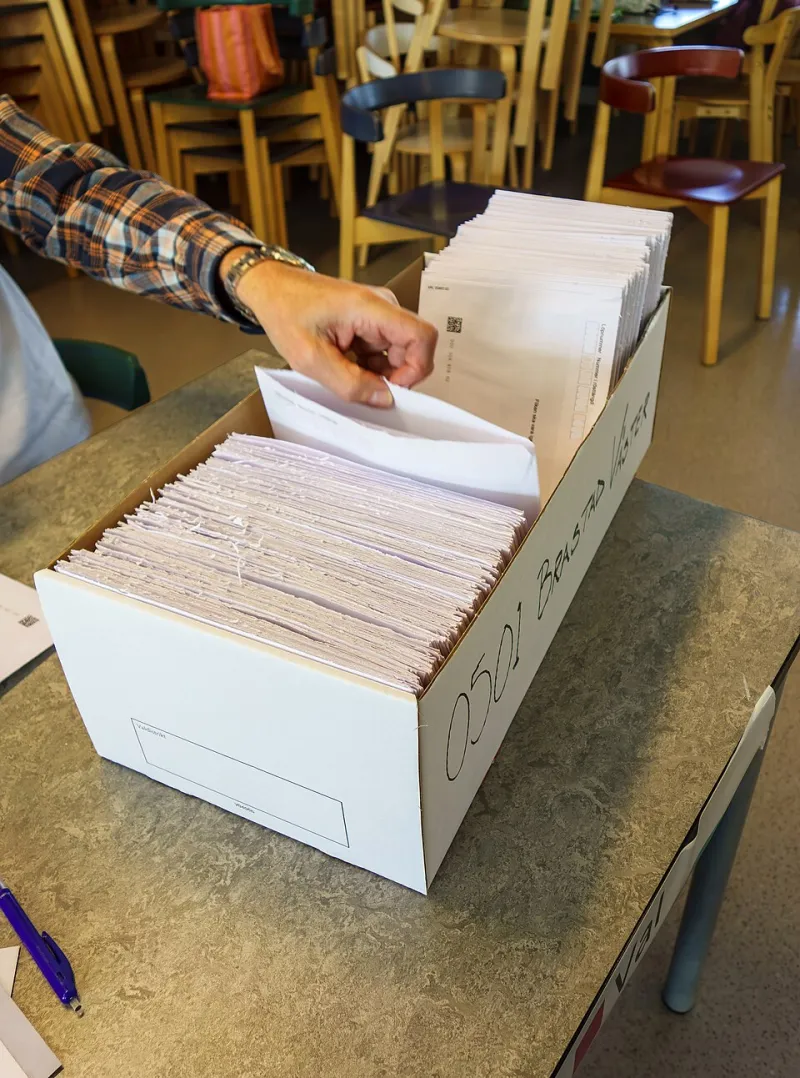
Photo: W.carter, CC BY 4.0, via Wikimedia Commons
In a converted warehouse on the edge of a mid-sized county seat, the machinery of an American election looks less like a civic ritual than a fulfillment operation. Pallets of paper arrive on trucks. Inserting machines fold and stuff envelopes. Software licensed from a company headquartered three states away matches the signature on each return envelope against a digitized record. The county clerk who signed the contract, swore in the temporary workers, and eventually certifies the result has no realistic way to inspect the code that decides which ballots advance and which are pulled for review.
That gap — between legal responsibility and operational control — is the central fact of modern election administration, and it is rarely discussed in the language of procurement. It surfaces instead as a security question, a partisan argument, or a budgeting headache. But the underlying arrangement is simpler and more consequential: the public owns the election, and private firms own most of the machinery that produces it.
A Market With Very Few Doors
Election logistics is not one industry so much as a chain of narrow ones. Ballot printing and mail fulfillment, envelope insertion and sorting, signature verification software, electronic pollbooks, accessible marking devices, central-count scanners, voter registration databases, and the networks that transmit results from precinct to county — each link has a short list of qualified suppliers, and some have effectively one.
Consolidation happened gradually, driven by certification costs, the expense of maintaining hardware for thousands of jurisdictions, and the simple fact that counties prefer vendors with a track record. The result is a market in which a handful of firms serve a large share of the country, and in which a county that wants to switch faces migration costs that can run into the millions.
Election equipment is certified — at the federal level on a voluntary basis, and by states under their own rules. But certification is a snapshot taken before deployment, not a continuing audit of a vendor's internal practices, staffing, or code changes. Once a system is approved, oversight largely depends on the diligence of individual jurisdictions, many of which employ a single election director and a few permanent staff.
How the Contracts Get Signed
The procurement record is uneven, and that unevenness is the story. Some states require competitive bidding for election services; others allow counties to piggyback on cooperative purchasing agreements negotiated elsewhere, which can spare local officials an RFP process but also narrows the field to vendors already on a state or national list.
Sole-source justifications are common, and often reasonable on their face: only the manufacturer can service its own equipment, and proprietary software is generally shielded from disclosure as a trade secret. Emergency declarations after a machine failure or a natural disaster can compress a months-long process into weeks. Multi-year renewals roll over with little public notice because the amounts fall below thresholds that would trigger a formal solicitation.
Contract terms tend to be written by the vendor. Liability caps, limitations on consequential damages, and clauses assigning responsibility for errors to the county are standard. When a mailing is delayed or a scanner is miscalibrated, the practical remedy is often a credit against next year's invoice rather than a public accounting of what went wrong.
When the Pipeline Breaks
Failures in this chain are usually small and local, which is precisely why they attract so little attention. Misprinted ballots discovered days before an election. Return envelopes with a defective glue seam. Signature verification systems that flag legitimate voters at elevated rates because a model was tuned elsewhere. Pollbooks that fail to sync with a statewide database on the morning of an election.
Each of these incidents is manageable when a county has in-house technical capacity and a responsive vendor. Each becomes a genuine crisis when it has neither. Election officials interviewed for this piece described a recurring pattern: the vendor is the only party with the diagnostic tools, so the county waits, and the public learns of the problem only if a local reporter asks the right question.
Transparency Stops at the Loading Dock
Public records requests for election contracts frequently run into trade secret exemptions, non-disclosure provisions, and security-based carve-outs. Some of these claims are legitimate — detailed network diagrams and physical security plans genuinely should not circulate — but the exemptions are often drafted broadly enough to cover pricing structures, performance history, and the substance of service-level agreements.
State legislatures have added their own layers. In recent years, several have moved to exempt election infrastructure information from disclosure, citing the risk of intrusion. The rationale is defensible. The side effect is that the public's ability to evaluate whether a county got a fair deal, or whether a vendor's performance justified renewal, has narrowed considerably.
The Oversight That Exists
There is no single agency that regulates election vendors as a class. Federal certification covers equipment, not companies. State election boards oversee procedures, not supply chains. County auditors examine spending, but rarely the technical substance of a contract. Post-election audits sample ballots and results, which is essential work but does not reach vendor operations.
What remains is a patchwork: diligent clerks, occasional legislative hearings, academic research, and reporters with time to file records requests. That is not nothing. It is also not a system designed to catch problems before they reach a ballot.
The remedies most often proposed are unglamorous — standardized contract language with audit rights, source code escrow, mandatory disclosure of ownership and conflicts, lower thresholds for competitive bidding, and dedicated funding so that small counties can hire someone capable of reading a service agreement. None would eliminate the vendor model. All would put the public in a better position to know what it is buying.
Until then, the loading dock remains the frontier. Beyond it, the ballots move, the machines count, and the people who answer for the outcome have only a contractual promise that everything went as planned.